Graphics Demo
Overview
The Graphics Demo is a UEFI application that uses the Graphics Output Protocol (GOP) to switch graphics modes and render directly into the framebuffer.
Unlike previous applications that only used text console output, this application performs pixel-level graphics rendering before an operating system is loaded.
Goal
The goal of this application is to understand how UEFI exposes graphics hardware through GOP and how firmware applications can draw directly into video memory.
What it demonstrates
- Locating
EFI_GRAPHICS_OUTPUT_PROTOCOL - Querying available graphics modes
- Switching modes using
SetMode() - Accessing framebuffer memory
- Plotting individual pixels
- Drawing lines and rectangles
- Separating console output from graphical rendering
GOP Workflow
The application follows this sequence:
    LocateProtocol()
            |
            v
    EFI_GRAPHICS_OUTPUT_PROTOCOL
            |
            v
    QueryMode()
            |
            v
    SetMode()
            |
            v
    Access framebuffer
            |
            v
    Render pixels and shapes
Framebuffer Rendering
After selecting a graphics mode, GOP provides:
- Framebuffer base address
- Framebuffer size
- Resolution
- Pixel format
- Pixels-per-scan-line information
Rendering is performed by writing pixel values directly into framebuffer memory.
Drawing Primitives
The demo implements several basic rendering primitives:
PutPixel()- Horizontal lines
- Vertical lines
- Rectangle outlines
- Filled rectangles
These primitives are sufficient to build simple user interfaces and debugging overlays.
Console vs Graphics
A useful observation is that text console output and framebuffer rendering are not the same subsystem.
The application reserves a region of the screen for graphics rendering while keeping console messages visible in another area.
This demonstrates the separation between:
- UEFI text console services
- GOP framebuffer rendering
Memory Ownership
An important detail discovered during development concerns QueryMode().
The function returns a buffer allocated by the graphics driver.
This means the caller must release the memory with FreePool() after the mode information is no longer needed.
This differs from APIs such as GetMemoryMap(), where the caller allocates the buffer itself.
Output
Example framebuffer rendering:
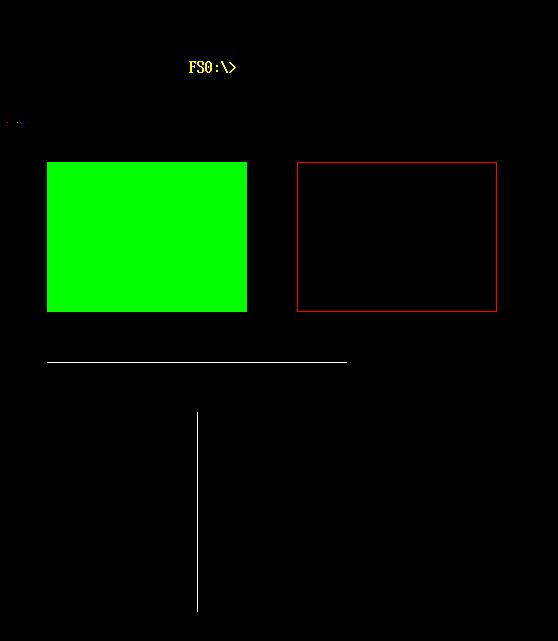
The demo draws colored rectangles and lines directly into video memory while running inside QEMU with OVMF firmware.
Related Concepts
Next Steps
The next stage of the project moves from standalone applications to boot loader development.